


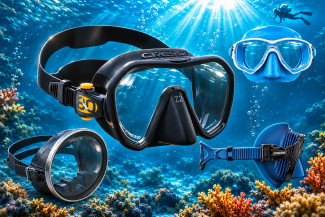
There are many well-established diving equipment manufacturers producing high-quality dive masks. Most of them offer a wide range of models — sometimes 10, 15 or even more — in different shapes, sizes, designs and colours.
With so many brands and models available, choosing a diving mask can be more difficult than it first appears.
The most important thing to remember is that people have different face shapes, and not every mask will fit every face equally well.
Some mask designs seem to fit a very wide range of faces. Others may fit some divers perfectly but simply do not seal comfortably on others.
This does not necessarily mean that one mask is better than another. A very good and expensive mask can still be completely wrong for your particular face.
For this reason, a diving mask is one piece of equipment that I strongly recommend you at least try on in a dive shop before buying.
If, for one reason or another, you decide to purchase a diving mask or any other diving equipment online, make sure you check the estimated delivery date and whether the item is actually in stock before placing your order.
This is important because some items advertised online may not be immediately available, and you could end up waiting much longer than expected for your equipment to arrive.
Before ordering a diving mask online, also check the seller's return and exchange policy. If the mask does not fit your face properly, you should know whether you can return or exchange it, within what period, and under what conditions.
Even better, if you have the opportunity, try the mask underwater before making your final decision.
Look for a Good-Quality Silicone Skirt
The material and quality of the mask skirt are important.
Modern good-quality diving masks generally use soft, flexible silicone skirts. Silicone can conform comfortably to the contours of the face and help create a reliable seal.
This is very different from the much stiffer rubber masks many divers will remember from the “ancient” days of recreational diving 60 or more years ago.
When choosing a mask, do not look only at the brand, colour or design. Feel the skirt and look for good-quality, soft and flexible silicone that sits comfortably against your face.
How to Try a Diving Mask in the Shop
There is a simple test you can do to see whether a mask is likely to fit your face properly.
Place the mask gently against your face without putting the strap around the back of your head.
First, make sure that your nose sits comfortably inside the nose pocket. You should also be able to reach and pinch your nose easily, because you will need to do this underwater when equalizing your ears.
Once the mask is comfortably positioned, inhale gently through your nose to create a slight vacuum inside the mask.
If the mask fits your face properly, it should seal against your face and stay in position without you holding it and without using the strap.
If you immediately feel air leaking into the mask and it loses the seal, adjust its position slightly and try again.
If it still does not seal properly, that particular mask may simply not be a good match for the shape of your face.
Don't Try to Fix a Poor Fit by Tightening the Strap
A common mistake is trying to compensate for a poorly fitting mask by tightening the strap.
The strap is there to keep the mask in position. It should not have to force a badly fitting mask against your face.
Overtightening the strap can make the mask uncomfortable and may not solve the problem at all.
A properly fitting mask should already create a good seal against your face during the simple dry test described above.
Single-Lens or Two-Lens Diving Mask?
Another thing to consider when choosing a diving mask is whether you prefer a mask with one continuous lens or two separate lenses.
A single-lens mask has one large piece of glass across the front. Because there is no central divider between the eyes, some divers find that this design gives them a more open and uninterrupted view.
A two-lens mask has separate lenses for the left and right eyes. These masks can sometimes be more compact and have a lower internal volume, although this depends on the particular model.
However, the number of lenses alone does not determine how wide your field of vision will be.
The shape and size of the lenses, their distance from your eyes and the overall design of the mask can all make a significant difference.
Some divers prefer the open feeling of a single-lens mask, while others find a two-lens design more comfortable or better suited to their face.
Neither design is automatically better. The most important thing is how well the mask fits and how comfortably you can see through it.
Field of Vision and Angled Lenses
When trying on different masks, pay attention not only to how much you can see directly in front of you, but also to your peripheral and downward field of vision.
Some diving masks have lenses that are angled slightly inward towards the bottom of the face. Depending on the design, this can improve your downward field of vision. A good example of this design is the blue mask in the bottom-right corner of the photo.
This can be particularly useful when looking at your dive computer, checking your equipment or observing something directly below you.
A mask with larger lenses does not necessarily provide a wider field of vision. A well-designed mask with smaller lenses positioned closer to your eyes may offer an equally good or even better view.
Try looking straight ahead, to the sides and downwards while wearing the mask.
You may be surprised by how different two masks can feel, even when they look quite similar from the outside.
Comfort and Internal Volume
A good seal and a comfortable field of vision are extremely important, but they are not the only things you should consider.
Pay attention to how the mask feels on your face. Check whether the silicone skirt makes comfortable and even contact with your skin and whether you feel uncomfortable pressure anywhere.
Internal volume also varies between mask designs. Some divers prefer a very low-volume mask, while others may be more comfortable with a different design.
Lower-volume masks generally require less air to clear and equalize the airspace inside the mask, but internal volume should not be your only consideration when choosing a mask for scuba diving.
For freedivers, however, a low-volume mask is particularly important. Unlike scuba divers, freedivers descend on a single breath and must use some of that limited air supply to equalize the pressure inside their mask as they descend. The smaller the airspace inside the mask, the less air they need to use for equalization, allowing them to conserve more of their precious breath-hold air supply.
There is no single mask that is perfect for everybody.
The Real Test Is in the Water
A proper dry fit test is usually a very good indication that a mask will fit you correctly.
However, the real test is in the water.
Although it is extremely rare, a mask that fits perfectly during a dry test may sometimes allow a small amount of water to enter once you are actually diving or snorkeling.
There is a simple reason why this can happen.
When you put a regulator or snorkel mouthpiece in your mouth, your mouth remains slightly open. In extremely rare cases, depending on the shape of your face, this can create small folds in the skin around your cheeks.
If one of these folds reaches the edge of the silicone skirt, it may interfere with the seal and allow a small amount of water to seep into the mask.
In my experience, this is extremely rare and is often related to the particular design and shape of the mask in combination with the diver's face — although this is not always the case.
This does not make the dry fit test unreliable. It remains one of the best ways to select a mask in a shop.
But if you have the opportunity to actually try the mask underwater before buying it, that is even better.
What About a Beard or Moustache?
Facial hair can also affect the seal of a diving mask.
Divers with a moustache or beard may sometimes find that hair underneath part of the silicone skirt prevents it from making complete contact with the skin. This can allow a small amount of water to enter.
However, having facial hair does not mean that you have to accept a leaking mask.
Try several good-quality masks with different shapes and skirt designs. In most cases, you should be able to find a mask that works very well with your particular face and facial hair.
Again, this is why I recommend choosing a mask based on fit, rather than simply choosing a particular brand or model because somebody else likes it.
Preparing a New Diving Mask
There is another important step that many new divers do not know about.
A brand-new diving mask may have manufacturing residue or a film on the inside surface of the glass. If this is not removed, the mask may fog very easily, and ordinary anti-fog treatment may not work as effectively as expected.
For masks with standard untreated tempered-glass lenses, one traditional method is to clean the inside of the lenses carefully with a mildly abrasive toothpaste, rinse thoroughly and repeat if necessary.
However, always check the manufacturer's instructions first.
Some modern masks have special anti-fog or other lens coatings that should not be scrubbed with toothpaste or treated in the traditional way.
You may also hear experienced divers talk about using a lighter to remove manufacturing residue from the inside of the glass. This method has been used by some divers for many years.
Personally, I do not recommend it as a general method.
A flame brought too close to the edge of the lens can potentially damage or deform the soft silicone skirt, and it may also be unsuitable for masks with special lens treatments. There is little reason to take that risk when a suitable cleaning method can be used instead.
When You Buy a Mask From Us
At Diving Center Sozopol, we give special attention to customers who are testing a mask with the intention of purchasing one.
We want you to choose a mask because it actually fits your face — not simply because it looks good in the box.
If you purchase a suitable standard glass mask from us, we can also help prepare it for its first use by cleaning the lenses appropriately to remove manufacturing residue that can contribute to fogging.
Where the manufacturer specifies a different preparation method or the mask has a special lens treatment, we follow the manufacturer's instructions instead.
We can also show you how to check the fit, adjust the strap correctly and look after your new mask.
Try Before You Buy
If you are diving with Diving Center Sozopol, you may be able to test one of our selected masks during your dive.
This gives you something that trying a mask in a shop cannot fully reproduce — the opportunity to actually breathe through a regulator, move normally underwater and see whether the mask remains comfortable and properly sealed throughout the dive.
We give particular attention to divers who are testing a mask because they are considering buying one. We can help you choose a suitable model, check the fit before entering the water and then let you make your own decision after actually using it.
If you like the mask you tested, you can purchase a brand-new mask of the same model, subject to availability.
You are not expected to purchase the demonstration mask that has already been used.
Or Take a Mask and Snorkel for a Short Test
You do not necessarily have to book a scuba dive with us just to test a mask.
Selected masks and snorkels may also be available for a short test period of 1–2 hours or longer, subject to availability and our rental conditions.
You can take the equipment to the beach, try it while swimming or snorkeling and see how it actually feels in the water.
If you like it, return the test equipment and purchase a brand-new mask or mask and snorkel set of the same model, subject to availability.
If it is not right for you, simply return the test equipment within the agreed period.
Refresh Your Diving Skills and Test Your Equipment
If you are a certified diver who has not been underwater for some time, a refresher session can be a good opportunity to regain confidence and practise essential diving skills.
At Diving Center Sozopol, we can arrange refresher sessions according to the season and suitable conditions.
During the colder months, refresher sessions can take place in a swimming pool, where you can practise in a controlled environment.
During the summer, we normally conduct refresher dives in the sea, allowing you to review your skills in real diving conditions.
Depending on your experience and individual needs, a refresher session may include assembling and checking your equipment, mask clearing, regulator skills, buoyancy control and other essential diving techniques.
A refresher session may also be an opportunity to try a different diving mask or other suitable equipment, subject to availability and prior arrangement.
The aim is simple: to help you feel comfortable, confident and ready to enjoy your next dive.
Take Care of Your Mask
Once you have found a mask that fits you well, take good care of it.
Always rinse your mask thoroughly with fresh water after every dive, particularly after diving in salt water.
Allow it to dry before storing it, preferably away from prolonged direct sunlight and excessive heat. Store it where the silicone skirt will not be crushed or permanently deformed by heavier diving equipment.
With some simple care, a good-quality diving mask can serve you well for many years.
Final Thoughts
There are many excellent diving masks on the market, and there is no reason why the most expensive one should automatically be the best one for you.
Your face is different from everybody else's.
Look for a mask made from good-quality, soft silicone. Make sure your nose fits comfortably in the nose pocket. Check that you can reach your nose easily for equalization. Test the seal without relying on the strap.
Consider whether you prefer one lens or two, and pay attention to the field of vision, especially when looking downwards. Make sure the mask is comfortable and that you are happy with the way it fits.
And whenever you have the opportunity, take the next step and test it in the water.
Don't choose a diving mask only because of the brand, the price or the way it looks. Choose the mask that fits you.
Try it on. If possible, try it in the water. Then decide if it is the right mask for you.