



This is one of the most common questions among divers during a diving course or a test dive. Air consumption depends on several factors. An experienced diver will have a lower air consumption because they will be more relaxed during the dive, an experienced diver will also be more hydrodynamic underwater and create less drag on the water which also reduces air consumption. A large role in air consumption is what the diver is doing during the dive, it is normal for a diver who is doing physical work underwater to breathe more often and therefore take in more air for the same dive and same time at depth compared to a diver who is on a pleasure dive and a walk.
The size of the diver's body also makes a big difference in air consumption. Human lung size is usually proportional to body size, therefore a diver who weighs 40 kg will have smaller lungs compared to a diver who weighs 100 kg.
If we say, as an example, that a diver who weighs 40 kg has a lung volume of 3 litres and a diver who weighs 100 kg has a lung volume of 6 litres, for every breath the diver who weighs 100 kg will take in twice as much air from the scuba tank compared to the diver who weighs 40 kg. Any increased resistance to water, such as swimming against a current, will increase air consumption.
Diving in extremely cold water causes divers to breathe a little more often, so air consumption also increases. The BIGGEST factor that plays a role in air consumption is depth, the deeper you are the greater your air consumption will be.
If we use a very common example used during a diving course and say that a diver sitting on a chair at the surface and breathing from a 10 litre scuba tank will exhale all the air from the scuba tank in one hour. Now let's say that same diver is going to use the exact same 10-liter scuba bottle filled to the same pressure as the example at the surface, but the diver is now sitting in the same chair, only at 20 meters deep, then he will run out of air in just 20 minutes.
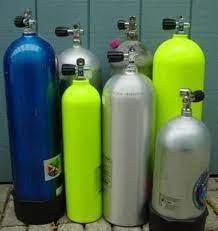
The diver will not feel anything different in the lungs. The pressure at 20 meters is 3 bar/at, therefore the air entering the diver's lungs will be 3 times denser compared to the surface and for every breath the diver takes, he/she will take in 3 times more air from the diver's tank. The amount of fill pressure of the dive tank obviously also matters. Dive tanks come in a variety of sizes, with the most common sizes being 11.1 liter aluminum tanks and 12 liter tanks. For deeper dives divers use 15, 18 and in some cases 20 litre tanks.